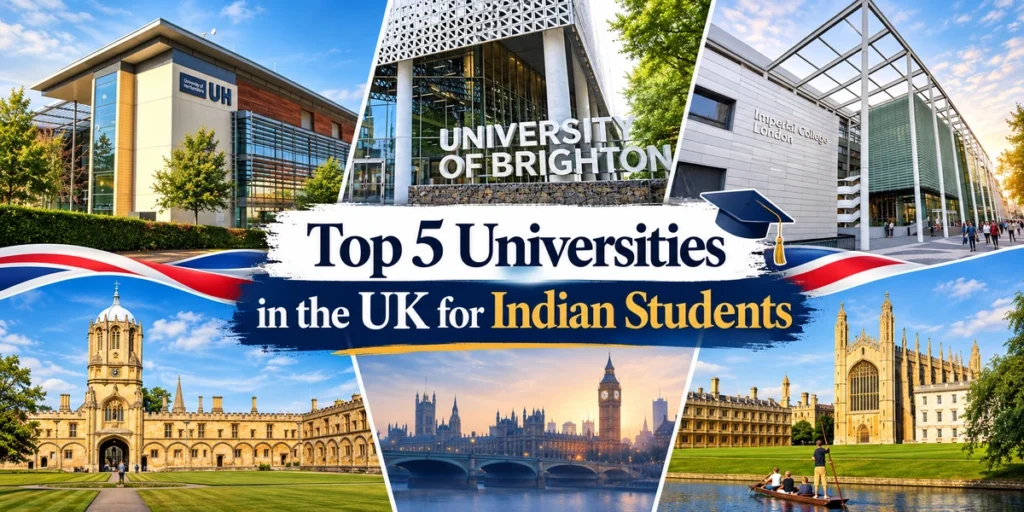
Choosing a university in the UK can be confusing, especially when you are comparing tuition fees, scholarships, course quality and future job opportunities. A highly ranked university may offer excellent research facilities, but it may not always match your budget or career goals.
For Indian students, the University of Hertfordshire and the University of Brighton offer career-focused courses, placement opportunities and international scholarships. Imperial College London specialises in science, engineering, medicine and business, while Oxford and Cambridge are known for their academic standards, research and competitive admissions.
These five universities represent different academic strengths and budgets. Whether you want an affordable postgraduate course, practical industry experience or a research-focused degree, understanding what each university offers can help you make a better decision.
If you are planning tostudy in the UK, this guide covers five universities worth exploring, including their fees, rankings, scholarships, admission requirements and work opportunities.
1. University of Hertfordshire
About the University of Hertfordshire
The University of Hertfordshire is a public university in Hatfield, England, established in 1952 as Hatfield Technical College. It gained university status in 1992 and has more than 70 years of educational history.
The university offers undergraduate, postgraduate, foundation and research programmes in business, engineering, computer science, healthcare, law and creative arts. It is around 25 minutes from central London by train and provides practical learning facilities and selected industry placement opportunities.
What Does the University of Hertfordshire Offer Indian Students?
For Indian students, Hertfordshire offers career-focused education, financial support and practical learning opportunities.
Tuition fees: Undergraduate and postgraduate fees with payment options.
Scholarships: International scholarships and eligible fee discounts.
Rankings: Recognition in major UK university rankings.
Courses: Business, engineering, computing and healthcare programmes with selected placements.
Admissions: Entry routes based on Indian academic qualifications and English proficiency.
University of Hertfordshire Fees for Indian Students
International tuition fees for 2026–27 depend on the selected course.
Course category
Tuition fees
Standard undergraduate
£17,450 per year
Standard postgraduate (1 year)
£17,950–£22,950
Selected extended postgraduate programmes
£19,950–£23,450
For example, MSc International Business and MSc Cyber Security have published international fees of £19,950.
Payment: International students generally need a minimum £5,000 deposit before receiving their Confirmation of Acceptance for Studies (CAS), although requirements vary by programme.
For January 2027 entry, 50% of tuition fees must generally be paid by registration or 8 February 2027, whichever comes first.
Source: University of Hertfordshire, International Tuition Fees and Liability Dates 2027–2028.
University of Hertfordshire Scholarships for Indian Students
The university offers scholarships and tuition discounts for eligible international students.
Scholarship
Award value
Chancellor’s International Scholarship
£500–£4,000
Super Early Bird Scholarship
£4,000
UG Tri Annual Scholarship
£2,000 per year
Full Payment Discount
£1,000
For the January 2027 Super Early Bird Scholarship, eligible postgraduate applicants must pay at least £5,000 by 31 October 2026.
Scholarship conditions vary, and awards cannot always be combined. Students should also explore otherscholarships in the UK.
Source: University of Hertfordshire, International Scholarships, January 2027.
University of Hertfordshire Ranking
University of Hertfordshire Ranking in the UK
Hertfordshire improved its position in major UK rankings for 2027.
Ranking publication
2026 rank
2027 rank
Guardian University Guide
49
37
Times and Sunday Times Good University Guide
67
59
Complete University Guide
82
70
The university climbed 12 places in the Guardian University Guide, reaching 37th in 2027.
Its Guardian subject rankings included:
1st: Animation and Game Design; Social Work
4th: Education
6th: Electrical and Electronic Engineering
Rankings vary because each guide uses different measures, including teaching, student satisfaction and graduate outcomes.
Sources: Guardian University Guide 2027; Times and Sunday Times Good University Guide 2027; Complete University Guide 2027.
University of Hertfordshire Courses and Fees
Hertfordshire offers programmes across business, technology, engineering, healthcare and creative subjects.
University of Hertfordshire Undergraduate Courses
Popular programmes include:
BSc Computer Science
BEng Mechanical Engineering
BA Business Administration
BSc Accounting and Finance
BA Animation and Game Art
Standard undergraduate international tuition is £17,450 annually for 2026–27, with course-specific exceptions.
University of Hertfordshire Postgraduate Courses
Postgraduate course
Tuition fees
MSc International Business
£19,950
MSc Cyber Security
£19,950
MSc Data Science and Machine Learning
£19,950
MSc Cyber Security with Placement Year
£22,450
Placement option: Selected programmes include a placement year. Students generally need to secure an approved placement, and additional living costs may apply.
Source: University of Hertfordshire, Course Fees 2026–27.
University of Hertfordshire Admission Requirements for Indian Students
Study level
Typical academic requirement
Undergraduate
Class 12 with 60–70%
Postgraduate
Bachelor’s degree with 55–65%
Foundation
Class 12 with approximately 50%
Standard undergraduate courses generally require IELTS 6.0, with no band below 5.5. Postgraduate requirements are commonly IELTS 6.0 or 6.5.
Some programmes accept approved Class 12 English results or equivalent qualifications. Indian students exploringstudy in the UK without IELTS should confirm their course’s requirements.
September and January intakes are available for selected programmes.
Source: University of Hertfordshire, India Entry Requirements.
University of Hertfordshire Work Opportunities and UK Work Rules
During studies
Eligible degree-level Student visa holders can generally work up to 20 hours weekly during term time.
Students employed directly by Hertfordshire or its Students’ Union are normally limited to 15 hours weekly under university employment rules.
Approved course placements may allow full-time work under the relevant conditions.
Self-employment is generally prohibited on a Student visa.
After graduation
For applications from 1 January 2027, eligible bachelor’s and master’s graduates can generally receive an 18-month UK Graduate visa, while doctoral graduates may receive three years.
A Graduate visa generally permits employment without sponsorship, but a job is not guaranteed.
Sources: UK Home Office, Student and Graduate Visa Rules; University of Hertfordshire, Student Employment Guidance 2026.
University of Hertfordshire Address and Accommodation
Campus
Address
College Lane
Hatfield, Hertfordshire, AL10 9AB, UK
de Havilland
Hatfield, Hertfordshire, AL10 9EU, UK
For 2026–27, advertised university accommodation starts at approximately £134.12 weekly for a twin en-suite room and £204.26 for a single en-suite room.
Students should budget separately for food, transport and personal expenses.
Source: University of Hertfordshire, Accommodation 2026–27.
Is the University of Hertfordshire a Good Choice for Indian Students?
Hertfordshire is worth considering for students interested in career-focused courses, selected placements and studying near London. Its scholarships and subject-specific strengths are useful, but students should compare the total cost and programme requirements before applying.
2. University of Brighton
About the University of Brighton
The University of Brighton is a public university in Brighton, England, whose history began in 1859 with the Brighton School of Art. It gained university status in 1992.
With more than 165 years of educational history, Brighton offers undergraduate, postgraduate and research programmes in business, computing, engineering, healthcare, education, architecture and creative arts. The university focuses on practical learning and professional development.
What Does the University of Brighton Offer Indian Students?
Brighton offers international students academic programmes, scholarships and opportunities to develop professional skills.
Tuition fees: Course-based fees for undergraduate, postgraduate and placement programmes.
Scholarships: International tuition discounts and eligible awards.
Rankings: Positions across major UK university guides.
Courses: Business, computing, engineering, healthcare and creative programmes.
Admissions: Entry options based on Indian qualifications and English-language requirements.
University of Brighton Fees for Indian Students
Brighton’s international tuition fees for 2026–27 vary by programme.
Course category
Tuition fees
Undergraduate courses
£17,796–£19,692 per year
Postgraduate taught courses
£17,748–£21,114
Selected undergraduate placement years
Course-specific
Medicine (BSMS)
£49,000 per year
Payment: International applicants generally need a £5,000 deposit before receiving their CAS.
Students should also consider accommodation, food, transport and visa expenses. Placement-year fees must be checked on the individual course page.
Source: University of Brighton, International Tuition Fees 2026–27.
University of Brighton Scholarships for Indian Students
The university offers several international scholarships and discounts.
Scholarship
Award value
Vice-Chancellor Undergraduate Scholarship
£4,000 over three years
Vice-Chancellor Postgraduate Scholarship
£2,000
Deans’ Global Talent Award (UG)
£1,500
Deans’ Global Talent Award (PG)
£500–£1,000
Future STEM Scholars’ Award
£2,500
January 2027 Early-Bird Discount
£500
The undergraduate Vice-Chancellor Scholarship provides £2,000 in the first year and £1,000 in each of the following two years.
The January 2027 early-bird discount has a published deadline of 24 November 2026 for eligible applicants.
Students should check programme eligibility, award combinations and applicable conditions before applying.
Source: University of Brighton, International Scholarships 2026–27.
University of Brighton Ranking
University of Brighton Ranking in the UK
Brighton holds different positions across major UK league tables.
Ranking publication
2026 rank
2027 rank
Guardian University Guide
110
117
Times and Sunday Times Good University Guide
90
77
Complete University Guide
88
104
Brighton improved by 13 places in the Times and Sunday Times Good University Guide, reaching 77th in 2027. However, its Guardian and Complete University Guide positions declined.
The Complete University Guide 2027 also placed Brighton 75th for Graduate Prospects – Outcomes.
These differences show why students should check subject-level performance and graduate outcomes rather than relying on one overall ranking.
Sources: Guardian University Guide 2026–27; Times and Sunday Times Good University Guide 2026–27; Complete University Guide 2026–27.
University of Brighton Courses and Fees
Brighton offers undergraduate and postgraduate programmes with practical learning opportunities.
University of Brighton Undergraduate Courses
Popular programmes include:
BSc Computer Science
BSc Data Science
BSc Business Management
BSc International Business Management
Engineering and Design courses
The published international tuition fee for BSc Computer Science, Data Science and Business Management is approximately £18,108 annually for 2026–27.
University of Brighton Postgraduate Courses
Students can explore:
MSc Management
Data Science and Computing
Engineering and Technology
Public Health
Architecture and Creative Industries
For example, MSc Management has a published international fee of £18,792 for 2026–27.
Placements: Selected courses include placement or research years. Fees, duration and eligibility vary, and placements are not guaranteed.
Source: University of Brighton, Course Directory and International Fees 2026–27.
University of Brighton Admission Requirements for Indian Students
Study level
Typical academic requirement
Undergraduate
Class 12 with 60–65%
Postgraduate
Recognised bachelor’s degree with 55% or above
Standard undergraduate programmes generally require IELTS 6.0 overall, with no component below 5.5. Some courses require higher scores.
Brighton also accepts approved English-language alternatives, including PTE Academic for eligible courses.
Students who do not qualify for direct entry can explore foundation or pre-sessional pathways.
Source: University of Brighton, India Entry Requirements.
University of Brighton Work Opportunities and UK Work Rules
During studies
Eligible degree-level students can normally work up to 20 hours weekly during term time.
Full-time work is generally allowed during official vacations.
One-year master’s dissertation periods may still count as term time.
Approved placements must meet university and visa conditions.
Self-employment is generally prohibited under a Student visa.
After graduation
Eligible bachelor’s and master’s graduates applying for a Graduate visa from 1 January 2027 can generally work in the UK for 18 months. Doctoral graduates may receive three years.
Students may need a Skilled Worker visa or another qualifying route to remain longer.
Sources: University of Brighton, Student Visa Work Guidance; UK Home Office, Graduate Visa Rules.
University of Brighton Address and Accommodation
Campus
Address
Moulsecoomb
Lewes Road, Brighton, BN2 4GJ, UK
Falmer
Village Way, Brighton, BN1 9PH, UK
City Campus
Grand Parade, Brighton, BN2 0JY, UK
A standard room with a shared bathroom at Varley Park is advertised at approximately £173 per week for 2026–27.
Eligible first-year students can receive an accommodation offer under the university’s published conditions and deadlines.
Source: University of Brighton, Accommodation 2026–27.
Is the University of Brighton a Good Choice for Indian Students?
Brighton is worth considering for students interested in practical education, professional development and studying in a coastal city. Its scholarships and courses are attractive, but applicants should compare tuition, living costs and their chosen subject’s outcomes.
3. Imperial College London
About Imperial College London
Imperial College London is a public research university established in 1907, with its main campus in South Kensington, London.
With more than 119 years of history, Imperial specialises in science, technology, engineering, medicine and business. Its programmes focus on advanced research, innovation and industry collaboration, making it particularly relevant to Indian students interested in technical and research-focused careers.
What Does Imperial College London Offer Indian Students?
Imperial offers specialist academic programmes, research facilities and professional development opportunities.
Tuition fees: Course-specific international fees, generally higher than many other UK universities.
Scholarships: Competitive funding for eligible overseas students.
Rankings: Strong positions in UK and international rankings.
Courses: Computing, engineering, natural sciences, medicine and business.
Admissions: Competitive entry requirements, with assessments for selected programmes.
Imperial College London Fees for Indian Students
Imperial’s international tuition fees depend on the course and entry year.
Programme
Published international fees
Undergraduate Engineering, 2026–27
£45,500 per year
Undergraduate Computing, 2026–27
£45,500 per year
MSc Computing, 2026–27
£46,000
Selected Engineering MSc programmes, 2026–27
Approximately £45,000
MSc Finance, 2026–27
Approximately £51,000
Imperial also publishes course-specific fees for 2027 entry. For example, Computing with an International Programme of Study lists an overseas fee of £47,800 per year.
Students should use the fee for their exact course and intake rather than assuming the same rate applies throughout Imperial.
Living expenses in London, accommodation and visa costs are additional.
Sources: Imperial College London, International Course Fees 2026–27 and 2027 Entry.
Imperial College London Scholarships for Indian Students
Imperial provides several competitive funding opportunities.
Scholarship
Financial support
Imperial Inspires Scholarship 2027
£15,000 per year for eligible recipients
President’s PhD Scholarships
Tuition funding and living stipend
Departmental Scholarships
Varies by programme
Business School Scholarships
Varies by course and eligibility
Imperial has announced at least 300 Imperial Inspires awards for eligible students entering in 2027, with specific application conditions.
PhD funding is also available through the President’s PhD Scholarships and selected departmental awards.
Students should confirm eligibility, deadlines and whether their intended course participates in each scholarship.
Source: Imperial College London, Scholarships and Funding Information 2027.
Imperial College London Ranking
Imperial College London Ranking in the UK
Imperial holds leading positions in UK and global university rankings.
Ranking publication
2026 rank
2027 rank
Guardian University Guide (UK)
6
5
Complete University Guide (UK)
6
5
Times and Sunday Times Good University Guide (UK)
6
3
QS World University Rankings (Global)
2
2
Imperial retained 2nd position globally in the QS World University Rankings 2027.
It also improved across the three UK league tables listed above.
These rankings reflect Imperial’s academic performance, research strengths, teaching and graduate outcomes, although each publication uses different criteria.
Sources: QS World University Rankings 2027; Guardian University Guide 2027; Complete University Guide 2027; Times and Sunday Times Good University Guide 2027.
Imperial College London Courses and Fees
Imperial focuses mainly on science, technology, engineering, medicine and business.
Imperial College London Undergraduate Courses
Popular programmes include:
BEng Computing
MEng Mechanical Engineering
MEng Aeronautical Engineering
BSc Mathematics
BSc Physics
MBBS Medicine
Overseas fees for many undergraduate Computing and Engineering programmes were £45,500 per year for 2026 entry.
Imperial College London Postgraduate Courses
Postgraduate course
Approximate 2026–27 international fee
MSc Computing
£46,000
Selected Engineering MSc programmes
£45,000
MSc Finance
£51,000
Imperial offers research projects, internships and selected placement opportunities, depending on the programme.
Students should confirm additional course expenses, internships and programme duration before applying.
Source: Imperial College London, Undergraduate and Postgraduate Course Directory 2026–27.
Imperial College London Admission Requirements for Indian Students
Imperial has competitive academic and English-language entry standards.
Study level
Academic requirement
Undergraduate
Accepted qualifications with high course-specific grades
Indian Class 12 applicants should confirm whether their qualification is accepted for their chosen course. Some programmes require additional admission assessments or interviews.
Imperial’s main IELTS standards are:
Standard: 6.5 overall, minimum 6.0 in each component.
Higher: 7.0 overall, minimum 6.5 in each component.
Approved English alternatives may also be accepted.
Source: Imperial College London, International Admissions and English Language Requirements.
Imperial College London Work Opportunities and UK Work Rules
During studies
Eligible degree-level Student visa holders can generally work up to 20 hours weekly during term time.
Full-time work is normally permitted during official vacations.
Master’s dissertation periods may count as term time.
Selected approved placements may permit full-time work.
Self-employment is generally prohibited on a Student visa.
After graduation
From 1 January 2027, eligible bachelor’s and master’s graduates applying for a Graduate visa can generally stay and work for 18 months. Eligible PhD graduates may receive three years.
Imperial provides career guidance and internship support, but jobs and placements are not guaranteed.
Sources: Imperial College London, Student Immigration and Work Guidance; UK Home Office, Graduate Visa Rules.
Imperial College London Address and Accommodation
Campus
Address
South Kensington
Exhibition Road, London SW7 2AZ, UK
White City
Wood Lane, London W12, UK
Hammersmith
Du Cane Road, London W12 0NN, UK
Imperial’s 2026 student budget guidance estimates around £250 weekly for university accommodation and £267 weekly for private accommodation.
Eligible first-year undergraduates may receive guaranteed accommodation under Imperial’s published conditions. Postgraduate accommodation is more limited.
Source: Imperial College London, Student Living Costs and Accommodation 2026.
Is Imperial College London a Good Choice for Indian Students?
Imperial is a strong option for students interested in science, computing, engineering, medicine and advanced research. Its global ranking and specialist facilities are major strengths, but high fees, London living costs and competitive admissions require careful planning.
4. University of Oxford
About the University of Oxford
The University of Oxford is a public research university in Oxford, England, with teaching recorded as early as 1096. With more than 900 years of educational history, it is the oldest university in the English-speaking world.
Oxford offers undergraduate, postgraduate and research programmes in medicine, law, engineering, computing, business, humanities and social sciences. Its college system and tutorial-based teaching are important parts of its academic approach.
What Does the University of Oxford Offer Indian Students?
Oxford offers research-intensive education, specialist facilities, scholarships and academic support.
Tuition fees: International fees based on course and study level.
Scholarships: Competitive undergraduate and postgraduate funding.
Rankings: Leading positions in UK university rankings.
Courses: Science, engineering, medicine, law, business and humanities.
Admissions: High academic requirements, with assessments and interviews for selected courses.
University of Oxford Fees for Indian Students
Oxford’s international tuition fees for 2027–28 vary significantly by programme.
Course category
International tuition fees
Undergraduate courses
£39,620–£66,580 per year
MSc Advanced Computer Science
£46,350
Clinical Medicine
Higher course-specific fees
The undergraduate fee range excludes higher overseas charges for the clinical years of Medicine.
Oxford also requires offer holders to complete a Financial Declaration Form confirming their ability to cover course fees and living costs.
For 2027–28, Oxford estimates living expenses of approximately £1,475–£2,175 monthly.
Sources: University of Oxford, Course Fees and Living Costs 2027–28.
University of Oxford Scholarships for Indian Students
Oxford provides competitive scholarship opportunities for eligible applicants.
Scholarship
Financial support
Clarendon Scholarship
Full course fees and living-cost grant
Rhodes Scholarship for India
Full postgraduate funding
Reach Oxford Scholarship
Tuition, living costs and travel support for eligible applicants
College and Departmental Scholarships
Varies
The Clarendon Fund offers more than 200 new scholarships annually. Eligible postgraduate applicants are considered when they apply by their course’s funding deadline.
The Rhodes Scholarship offers five awards for India, subject to its own eligibility and selection process.
Undergraduate scholarship availability is more limited, and students must confirm whether India is included in an award’s eligible-country list.
Sources: University of Oxford, Scholarships and Funding 2027; Rhodes Trust.
University of Oxford Ranking
University of Oxford Ranking in the UK
Oxford holds leading positions in UK rankings.
Ranking publication
2026 rank
2027 rank
Guardian University Guide
1
1
Complete University Guide
2
2
Oxford maintained 1st position in the Guardian University Guide 2027 and 2nd in the Complete University Guide.
The Complete University Guide 2027 also ranked Oxford fourth for Graduate Prospects – Outcomes and second for Research Intensity.
Different ranking publications consider academic performance, student experience and graduate outcomes using different measures.
Sources: Guardian University Guide 2026–27; Complete University Guide 2026–27.
University of Oxford Courses and Fees
Oxford offers undergraduate, postgraduate and research programmes across several academic disciplines.
University of Oxford Undergraduate Courses
Popular programmes include:
Computer Science
Engineering Science
Economics and Management
Law (Jurisprudence)
Mathematics
Medicine
For 2027–28, overseas undergraduate tuition generally ranges from £39,620 to £66,580 annually, with higher clinical Medicine fees.
University of Oxford Postgraduate Courses
Popular programmes include:
MSc Advanced Computer Science
MSc Financial Economics
MSc Law and Finance
MSc Statistical Science
MSc Global Healthcare Leadership
MBA
For example, MSc Advanced Computer Science has a published overseas course fee of £46,350 for 2027–28.
Practical experience: Oxford provides research projects, careers support and internship resources, although professional placements depend on the course.
Source: University of Oxford, Undergraduate and Graduate Course Directory 2027–28.
University of Oxford Admission Requirements for Indian Students
Oxford assesses Indian applicants according to their qualifications and selected course.
Study level
Academic requirement
Undergraduate
Accepted CBSE, CISCE ISC or equivalent qualifications meeting course-specific requirements
Postgraduate
Recognised bachelor’s degree with strong academic results
Research
Relevant qualifications and research suitability
Not all Indian examination boards or qualifications are accepted for every undergraduate course.
Selected programmes require admissions tests, written work and interviews. Graduate IELTS requirements are commonly 7.0 or 7.5 overall, depending on the course.
Important: Oxford’s main undergraduate application deadline for 2027 entry was 15 October 2026. Students preparing for a future intake should check the next application cycle.
Source: University of Oxford, International Qualifications and Admissions 2027.
University of Oxford Work Opportunities and UK Work Rules
During studies
Eligible degree-level Student visa holders can generally work up to 20 hours weekly during term time under UK rules.
Oxford also applies its own academic and employment guidance.
Research students must follow their approved vacation arrangements.
Self-employment is generally prohibited under a Student visa.
After graduation
Eligible bachelor’s and master’s graduates applying from 1 January 2027 can generally receive an 18-month Graduate visa. Doctoral graduates may receive three years.
Oxford provides career resources and internship opportunities, but students must meet university and immigration conditions before working.
Sources: University of Oxford, Working While Studying; UK Home Office, Student and Graduate Visa Rules.
University of Oxford Address and Accommodation
Oxford’s colleges and academic departments are spread throughout the city.
Location
Address
University of Oxford
Wellington Square, Oxford OX1 2JD, UK
Unlike a single-campus institution, accommodation arrangements vary by college.
For 2027–28, Oxford estimates accommodation expenses of approximately £880–£1,025 per month, with total living costs around £1,475–£2,175 monthly.
Students should check their college’s room availability, rent and contract conditions.
Source: University of Oxford, Living Costs and Accommodation 2027–28.
Is the University of Oxford a Good Choice for Indian Students?
Oxford is suitable for academically competitive students interested in research-intensive programmes and personalised teaching. Its academic reputation and scholarships are major advantages, but admission standards, international fees and living expenses require careful preparation.
5. University of Cambridge
About the University of Cambridge
The University of Cambridge is a public research university in Cambridge, England, established in 1209. With more than 800 years of academic history, it is one of the oldest universities in the world.
Cambridge has 31 colleges and offers undergraduate, postgraduate and research programmes in engineering, computer science, medicine, business, law, natural sciences and humanities. It is known for small-group supervision teaching, research and college-based education.
What Does the University of Cambridge Offer Indian Students?
Cambridge offers academic programmes, research facilities, scholarships and career support.
Tuition fees: Course-specific international fees, plus college fees and living expenses.
Scholarships: Competitive undergraduate and postgraduate financial support.
Rankings: Leading positions in major UK university rankings.
Courses: Engineering, computing, medicine, business, law and humanities.
Admissions: High academic standards, with tests and interviews for selected courses.
University of Cambridge Fees for Indian Students
International undergraduate tuition fees for 2027–28 depend on the selected course.
Course category
Annual tuition fees
Arts, Humanities, Law and Economics
£30,798
Mathematics
£34,356
Architecture, Design and Geography
£40,296
Computer Science, Engineering and Natural Sciences
£46,872
Medicine and Veterinary Medicine
£70,554
Important: International undergraduates normally pay an additional college fee. The table excludes college fees and living expenses.
Postgraduate tuition and college costs depend on the programme. Cambridge estimates average living costs of around £1,330 monthly for 2027–28.
Source: University of Cambridge, International Fees and Living Costs 2027–28.
University of Cambridge Scholarships for Indian Students
Cambridge offers competitive financial support through several scholarship programmes.
Scholarship
Financial support
Gates Cambridge Scholarship
Full postgraduate funding
Cambridge Trust Scholarships
Partial or full funding
Cambridge International Scholarships
Funding for eligible PhD applicants
College and Departmental Awards
Varies
Undergraduate funding for international students is limited, and many awards provide partial support.
For 2027–28 postgraduate entry, major funding deadlines include 8 December 2026 and 6 January 2027, depending on the programme.
Students should check course eligibility and submit applications before the relevant funding deadline.
Sources: University of Cambridge, International Financial Support and Postgraduate Funding 2027–28.
University of Cambridge Ranking
University of Cambridge Ranking in the UK
Cambridge holds leading positions in UK university rankings.
Ranking publication
2026 rank
2027 rank
Guardian University Guide
3
2
Complete University Guide
1
1
Times and Sunday Times Good University Guide
4
4
Cambridge improved to 2nd in the Guardian University Guide 2027 and maintained 1st position in the Complete University Guide.
It also achieved first place in several Guardian subject rankings, including Biology, Engineering, Education, Psychology and Politics.
Students should compare the academic strength of their preferred course alongside overall university rankings.
Sources: Guardian University Guide 2027; Complete University Guide 2027; Times and Sunday Times Good University Guide 2027.
University of Cambridge Courses and Fees
Cambridge offers undergraduate, postgraduate and research programmes across academic and professional disciplines.
University of Cambridge Undergraduate Courses
Popular programmes include:
Computer Science
Engineering
Economics
Mathematics
Law
Medicine
International undergraduate tuition for 2027–28 ranges from £30,798 to £70,554 annually, excluding college fees.
University of Cambridge Postgraduate Courses
Popular programmes include:
MPhil Advanced Computer Science
MPhil Management
MPhil Engineering
MPhil Economics
MPhil Machine Learning and Machine Intelligence
MBA
Postgraduate fees depend on the course and college. Applicants should check the university’s official course directory and fee calculator.
Practical experience: Cambridge offers research projects, career events and internship resources. Industry placements are not guaranteed.
Source: University of Cambridge, Course Directory 2027–28.
University of Cambridge Admission Requirements for Indian Students
Cambridge has competitive academic and English-language requirements.
Study level
Academic eligibility
Undergraduate
Accepted Class 12 or international qualifications meeting course requirements
Postgraduate
Recognised bachelor’s degree with high academic achievement
PhD
Strong academic qualifications and research suitability
Not every Indian board or qualification is accepted for every undergraduate programme.
Selected courses require assessments such as ESAT, TMUA or STEP, and shortlisted applicants may attend interviews.
Undergraduate English requirements commonly include IELTS 7.5 overall, with a minimum 7.0 in each component. Postgraduate requirements vary.
The main undergraduate UCAS deadline for 2027 entry was 15 October 2026.
Source: University of Cambridge, International Entry Requirements 2027.
University of Cambridge Work Opportunities and UK Work Rules
During studies
Eligible degree-level Student visa holders can generally work up to 20 hours weekly during term time under UK immigration rules.
Cambridge normally expects undergraduate and full-time taught postgraduate students not to undertake paid work during term time.
Vacation work may be permitted under applicable conditions.
Self-employment is generally prohibited on a Student visa.
After graduation
Eligible bachelor’s and master’s graduates applying for a Graduate visa from 1 January 2027 can generally stay and work for 18 months. Doctoral graduates may receive three years.
Cambridge provides career support, but students should not rely on term-time employment to fund their studies.
Sources: University of Cambridge, Working While Studying; UK Home Office, Graduate Visa Guidance.
University of Cambridge Address and Accommodation
Cambridge has 31 colleges, with departments and facilities spread across the city.
Location
Address
University of Cambridge
The Old Schools, Trinity Lane, Cambridge CB2 1TN, UK
Accommodation is generally arranged through individual colleges.
For 2027–28, Cambridge estimates average accommodation expenses of approximately £880 per month and total living costs of around £1,330 monthly.
Room availability, fees and accommodation contracts depend on the college.
Source: University of Cambridge, Living Costs and College Accommodation 2027–28.
Is the University of Cambridge a Good Choice for Indian Students?
Cambridge is worth considering for academically competitive students interested in research, specialised teaching and internationally recognised qualifications.
Its college system, academic reputation and postgraduate funding opportunities are important advantages. However, high fees, limited undergraduate funding and selective admissions require early planning.
How to Choose the Right UK University as an Indian Student?
If I were an Indian student choosing a UK university, I would first check five things: course suitability, total study costs, admission eligibility, scholarships and career opportunities. I would then shortlist universities based on my priorities.
University of Hertfordshire: If I wanted comparatively affordable tuition fees, career-focused courses and placement options near London.
University of Brighton: If I preferred practical learning, creative or professional courses and international scholarships.
Imperial College London: If I had strong academic results, a higher budget and wanted to specialise in engineering, computing or science.
University of Oxford: If I wanted research-intensive education, personalised teaching and could meet highly competitive admission requirements.
University of Cambridge: If I was interested in mathematics, science, engineering or advanced research and could meet its academic and funding requirements.
Before making my final decision, I would compare the exact course fees, scholarship eligibility, living expenses and employment opportunities. I would choose the university that best fits my academic profile, financial situation and long-term career goals rather than relying on rankings alone.
Explore the Top 10 Cheapest UK Universities for International Students
Not every Indian student needs to choose an expensive or highly ranked university. Your ideal university should also match your budget, academic background and career plans.
Oxford, Cambridge and Imperial College London are strong choices for highly competitive academic and research programmes. Hertfordshire and Brighton are also worth considering for their career-focused courses, scholarships and different fee structures. The best choice depends on the student's goals and budget.
Among the five universities discussed, the University of Hertfordshire has a published standard undergraduate international fee of £17,450 for 2026–27. However, specific course fees and scholarship discounts can change the comparison.
Yes, it can be a suitable option for students interested in business, engineering, computing and other professional programmes. Its subject rankings, selected placement courses and location near London are worth considering.
Brighton offers practical courses, international scholarships and selected placement opportunities. Indian applicants should compare its course-specific fees, academic strengths and Brighton's living costs before deciding.
Yes. Imperial has competitive admissions, particularly in engineering, computing, medicine and science. Applicants need strong academic qualifications and may have to complete admission assessments or interviews.
Start with the course you want to study. Then compare entry requirements, tuition fees, scholarships, subject rankings, accommodation costs and career opportunities.
A university with a higher overall ranking is not automatically the best fit for every student. If you need support with course selection, applications and admission requirements, an experiencedUK education consultant can help you evaluate your options.
Varun Gupta – Founder, IOES | Study Abroad Consultant
Hi, I am Varun Gupta, Founder of IOES, a study abroad consultant in Gurgaon. I bring over 15 years of professional experience, including my previous role as Team Leader with the Department of Immigration and Border Protection (DIBP) at the Australian High Commission, New Delhi.
My background includes Australian immigration procedures, client services, and regulatory processes. Through IOES, I aim to help students make informed decisions about overseas education, university selection, admissions, and student visa requirements.
I share practical insights to help students and parents better understand the study abroad process and plan their international education journey with confidence.
RELATED BLOG
Related Insights & Perspectives
Lorem ipsum dolor sit amet, consectetur adipiscing elit, sed do eiusmod tempor incididunt ut labore et dolore magna aliqua. Ut enim ad minim veniam, quis nostrud exercitation ullamco laboris.
The United Kingdom remains one of the most sought-after study destinations for students worldwide. With globally recognized degrees, excellent academic ...