- +9193554 51451
- info@ioes.in
- Mon - Sat (10:00AM - 6:00PM)

A Statement of Purpose (SOP) is one of the most important documents required when applying to universities abroad. Whether you are applying for a bachelor’s degree, master’s program, MBA, internship, scholarship, or student visa, a well-written SOP can significantly improve your chances of acceptance.
Many students have excellent academic records but struggle to explain their goals, achievements, and motivations effectively. This is where a strong Statement of Purpose helps. It gives admissions committees a clear understanding of who you are, what you have accomplished, why you want to pursue a specific course, and how it aligns with your future aspirations.
If you are wondering what a statement of purpose is, how to write an SOP, or looking for a statement of purpose format, this guide covers everything you need to know.
What is a Statement of Purpose (SOP)?
A Statement of Purpose (SOP) is a formal document required by many universities and colleges during the admission process for study abroad programs. It explains your academic background, professional experience, career objectives, and the reasons for choosing a specific course and institution. The SOP helps admission committees understand who you are beyond your grades, test scores, and academic records.
More than just an application document, an SOP allows you to present your personal journey, achievements, aspirations, and motivation for pursuing higher education abroad. It demonstrates how your past experiences have shaped your academic interests and how the chosen program aligns with your future career goals.
Universities use the Statement of Purpose to evaluate an applicant’s clarity of purpose, communication skills, academic potential, and suitability for the selected course. A well-written SOP can strengthen your application by highlighting your unique strengths, experiences, and long-term vision, helping admission officers understand the value you can bring to their academic community.
For students planning to study abroad, the SOP often becomes one of the most important components of the university application process because it provides an opportunity to differentiate themselves from other applicants and make a strong first impression on the admissions committee.

SOP Full Form in Education
The SOP full form in education is Statement of Purpose.
It is commonly required for:
- Undergraduate admissions
- Master’s programs
- MBA applications
- Doctoral studies
- Scholarships
- Exchange programs
- Research opportunities
Educational institutions use SOPs to understand a student’s academic journey and future aspirations.
SOP Full Form in Visa Applications
The SOP full form in visa applications is also Statement of Purpose.
Many countries, including Canada and Australia, may require applicants to submit an SOP explaining:
- Why they chose the country
- Why they selected a specific institution
- Their source of funds
- Career plans after graduation
- Intentions to comply with visa regulations
A visa SOP focuses more on genuine study intentions and financial preparedness than academic achievements.
Why Is an SOP Important?
A Statement of Purpose can significantly influence admission decisions because it provides insights that grades and test scores cannot.
Benefits of a strong SOP include:
- Improves admission chances
- Demonstrates academic motivation
- Highlights career objectives
- Showcases achievements and experiences
- Helps secure scholarships
- Supports student visa applications
- Differentiates you from other applicants
A well-structured SOP often becomes the deciding factor between candidates with similar academic profiles.
What Should a Statement of Purpose Include?
An effective Statement of Purpose should tell a coherent story about your academic and professional journey.
Academic Background
Discuss:
- Educational qualifications
- Relevant coursework
- Academic achievements
- Research projects
- Certifications
Admissions committees want to understand how your academic background has prepared you for the program.
Professional Experience
If applicable, mention:
- Internships
- Full-time employment
- Freelance projects
- Leadership roles
- Industry certifications
Professional experiences should directly relate to your chosen field of study whenever possible.
Career Goals
Clearly explain:
Short-Term Goals
What you plan to do immediately after graduation.
Long-Term Goals
Where you see yourself in five to ten years.
Universities prefer applicants who have a clear vision of their future.
Reasons for Choosing the Course
Admissions officers want to know why you selected a specific course.
You should explain:
- Your interest in the field
- Industry demand
- Personal experiences
- Academic motivations
Avoid generic statements such as “I have always been passionate about this field.”
Instead, provide specific examples and experiences.
Reasons for Choosing the University
Demonstrate that you have researched the institution thoroughly.
Mention:
- Faculty expertise
- Research opportunities
- Curriculum structure
- Laboratories
- Industry collaborations
- Global rankings
A personalized SOP appears far more convincing than a generic application.
Future Plans After Graduation
Universities value applicants who have realistic and achievable plans.
Discuss:
- Career aspirations
- Industry goals
- Entrepreneurship plans
- Research ambitions
- Contribution to society
What is the Statement of Purpose Format?
A well-organized Statement of Purpose format improves readability and professionalism.
| SOP Section | Purpose |
|---|---|
| Introduction | Introduce yourself and your motivation |
| Academic Background | Educational achievements and experiences |
| Professional Experience | Work and internship experiences |
| Career Goals | Short-term and long-term objectives |
| Why This University | Reasons for choosing the institution |
| Conclusion | Summary and future aspirations |
Recommended SOP Length
Although requirements vary by institution, most universities prefer:
| Program Type | Word Count |
|---|---|
| Bachelor's Degree | 500–800 Words |
| Master's Degree | 800–1200 Words |
| MBA Programs | 1000–1500 Words |
| PhD Applications | 1200–2000 Words |
Statement of Purpose Format ISC
Students often search for the statement of purpose format ISC for academic applications.
A typical ISC SOP includes:
- Personal introduction
- Educational achievements
- Academic interests
- Career objectives
- Program relevance
- Future plans
The format remains similar to university SOP requirements but may vary according to specific guidelines.
How to Write SOP?
One of the most common questions students ask is how to write a statement of purpose effectively.
The answer lies in following a structured approach.
Step 1: Understand University Requirements
Before writing your SOP:
- Review application instructions
- Understand word limits
- Identify key questions
- Analyze program expectations
Every university has different priorities.
Step 2: Research the Program
Study:
- Curriculum
- Faculty profiles
- Research centers
- Internship opportunities
- Career outcomes
This information helps you personalize your application.
Step 3: Create an SOP Outline
Organize your content before writing.
Your outline should include:
- Introduction
- Academic history
- Professional experience
- Career goals
- University fit
- Conclusion
A clear structure ensures better flow and readability.
Step 4: Write a Strong Introduction
Your introduction should capture attention immediately.
Include:
- Academic interests
- Personal motivations
- Professional aspirations
Avoid clichés and generic opening statements.
Step 5: Highlight Academic Achievements
Discuss:
- Academic accomplishments
- Projects
- Research work
- Competitions
- Certifications
Focus on experiences that relate directly to your chosen program.
Step 6: Explain Professional Experience
For students with work experience, explain:
- Key responsibilities
- Technical skills
- Leadership experiences
- Industry exposure
Demonstrate how these experiences influenced your decision to pursue further education.
Step 7: Discuss Career Goals
Clearly define:
Short-Term Objectives
Examples:
- Industry roles
- Specialized positions
- Research opportunities
Long-Term Objectives
Examples:
- Senior leadership
- Entrepreneurship
- Academic research
Admissions committees appreciate applicants with well-defined goals.
Step 8: Write a Memorable Conclusion
The conclusion should reinforce:
- Academic readiness
- Professional aspirations
- Commitment to success
Avoid introducing new information in the final paragraph.
Step 9: Proofread and Edit
Before submission:
- Check grammar
- Eliminate spelling errors
- Improve sentence flow
- Verify facts
- Remove repetition
A polished SOP creates a positive impression.
Statement of Purpose (SOP): Different Programs
A Statement of Purpose (SOP) is a key document required for admission to various study programs abroad. It explains your academic background, career goals, and reasons for choosing a specific course and university. Different programs like MBA, Masters, Business Analytics, or Engineering require tailored SOPs that highlight relevant skills and goals specific to each field.
Statement of Purpose for Masters
A Statement of Purpose for Masters programs focuses on academic background, specialization interest, and career goals.
Key points to include:
- Strong academic foundation in relevant field
- Research interest in specialization
- Relevant projects or internships
- Clear career progression plan
Example Focus Areas:
- Data Science
- Engineering
- Business Analytics
- Public Health
- Computer Science
A strong SOP for Masters should clearly explain why you are moving from undergraduate to postgraduate studies and how it supports your long-term goals.
Statement of Purpose for MBA
An SOP for MBA applications is more focused on leadership, management skills, and career growth.
Key elements:
- Professional work experience
- Leadership roles
- Business achievements
- Career advancement goals
Example MBA SOP Focus:
- Why MBA is needed now
- Career transformation goals
- Industry experience
- Management skills development
MBA SOPs should clearly demonstrate how the program will help you transition into leadership or managerial positions.
Statement of Purpose for Internship
An SOP for internship applications highlights skills, learning intent, and career exploration.
Include:
- Academic background
- Technical skills
- Interest in industry exposure
- Learning objectives
Focus Areas:
- Skill development
- Practical experience
- Career exploration
Internship SOPs are generally shorter and more direct than university SOPs.
SOP for College Admissions
For undergraduate or college admissions, SOPs focus more on:
- Academic performance in school
- Interest in chosen subject
- Extracurricular activities
- Future academic goals
Key Objective:
To show your passion and readiness for higher education.
Statement of Purpose Sample
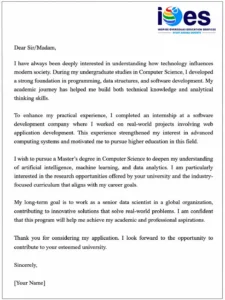
A well-written Statement of Purpose sample helps students understand how to structure their own SOP effectively. Below is a general sample for study abroad applications.
SOP vs Personal Statement
Many students confuse SOP with a personal statement. However, both serve different purposes.
| Statement of Purpose | Personal Statement |
|---|---|
| A Statement of Purpose highlights your background, achievements, goals, and suitability for the chosen program. | A personal statement explains your motivation for studying a specific course, highlighting your experiences, achievements, skills, and future goals. |
| Academic and career focused | Personal life focused |
| Structured format | More flexible |
| Goal-oriented | Story-oriented |
| Used for universities & visas | Used in some university applications |
What Should You Avoid When Writing an SOP?
A weak SOP can reduce your chances of admission. Avoid these mistakes:
- Copy-Pasting SOP Samples: Universities can detect plagiarism easily.
- Lack of Clear Career Goals: Vague goals make your application weak.
- Overuse of Generic Statements: Avoid phrases like:
- “I am passionate about this field.”
- “I always wanted to study abroad.”
- Poor Structure: Unorganized SOPs reduce readability.
- Grammatical Errors: Mistakes can create a negative impression.
- Exceeding Word Limit: Always follow university guidelines.
Expert SOP Writing Tips
To write a powerful Statement of Purpose:
Do’s:
- Be honest and authentic
- Use real-life examples
- Maintain a clear structure
- Customize for each university
- Highlight achievements
Don’ts:
- Do not exaggerate achievements
- Avoid irrelevant information
- Do not use informal language
- Avoid repetition
A strong SOP should sound natural, professional, and goal-oriented.
What to include in the Statement of Purpose?
There is no fixed format for writing a Statement of Purpose (SOP). The content and structure may differ depending on the course, level of study, university, and destination country. However, your SOP should be unique, authentic, and clearly address the key questions that the admissions committee wants to understand about your academic background, goals, and motivation.
A Complete Checklist for Writing an Impressive SOP:
| Checklist | Status |
|---|---|
| 1. Personal background | ✓ |
| 2. Academic achievements | ✓ |
| 3. Financial background | ✓ |
| 4. Professional experiences | ✓ |
| 5. Immediate and long-term goals | ✓ |
| 6. Reasons for choosing a particular institution | ✓ |
| 7. Why should you be selected for the applied course/university? | ✓ |
| 8. Why are you interested in the chosen study field? | ✓ |
| 9. Extra-curricular activities | ✓ |
| 10. Projects you've worked on | ✓ |
| 11. Papers submitted (if any) | ✓ |
| 12. Awards and achievements | ✓ |
| 13. Interests and hobbies | ✓ |
How We Help You Write a Strong SOP
At IOES, we help students create impactful and admission-ready Statements of Purpose.
Our Services Include:
- Personalized SOP writing guidance
- University-specific SOP structuring
- Country-wise SOP support
- MBA, Masters, and internship SOP assistance
- SOP review and editing
- Visa SOP support
We ensure your SOP meets international admission standards and improves your acceptance chances.
Read more insightful articles
| SOP for Canada | SOP for Australia | SOP for the UK |
| SOP for New Zealand | SOP for MBA | SOP for Masters |
| SOP for Business Analytics | SOP for Masters in Data Science | Do's and Don'ts When Writing Your SOP |
Frequently Asked Questions (FAQs)
A Statement of Purpose is a document that explains your academic background, goals, and reasons for choosing a specific course and university.
SOP full form is Statement of Purpose.
Most SOPs range between 800–1200 words depending on the program.
Start with your motivation, academic interest, or a meaningful experience related to your field.
SOP is used for university admissions, scholarships, internships, and visa applications.
No, you should customize each SOP based on university requirements.
SOP focuses on academic and career goals, while personal statements focus on personal experiences.
Yes, in many countries SOP plays a key role in visa approval.